
Showing posts with label Kevis Pinto. Show all posts
Showing posts with label Kevis Pinto. Show all posts
Wednesday, February 5, 2014
Global Scope: 2014 FIBA World Cup


Wednesday, December 11, 2013
Global Scope: FIFA World Cup Prediction

The 2014 FIFA World Cup final draw, held in Costa do Sauipe last Friday December 6th, decided which teams are facing each other in the tournament's group stages. It also awarded fans with the possibility of simulating what the road could be like for each team in order to go all the way. As of right now we still have to wait 182 days until Brazil and Croatia take to the field in Sao Paulo for the inaugural match on June 12, 2014. It is obviously too early for a real prediction, but it is never too early to feed our curiosity and see which match-ups could arise through a simulation.
Thursday, November 14, 2013
Global Scope: Farewell to a Cricket Legend
At the end of the week, one of the greatest athletes of our time and a true cricket phenomenon will be playing his last test match ever, an unparalleled 200th! Ultimately it will be the last chance India fans have to watch their star batsman Sachin 'The Little Master' Tendulkar in action, since he has recently retired from T20s and One Day Internationals (ODIs) already. This could essentially mean the sun is setting for Tendulkar's gigantic brand, who's appeal basically dominated the big money game in India, selling a dozen of products every year. Actually, his brand allure was on full display this week after a massive crowd of people swarmed the Wankhede Stadium in Tendulkar's hometown of Mumbai in order to get tickets for his farewell match on November 14. Unfortunately for those fans only 6,000 tickets were being sold online, and the website offering the services (Kyazoonga.com) crashed after a record 19.7 million hits were registered. This may seem as a surprise, but if you ask anyone in the streets of Mumbai what they think of Sachin Tendulkar, chances are they'll respond with a popular local saying: "Cricket is our religion and Sachin is our God."
Wednesday, April 3, 2013
Global Scope: The Lionel Messi Line
Different people have different theories as to why soccer has never "made it" in the United States of America. Some people say that it is because soccer players are great actors, who dive throughout the game urging the referees to call fouls which did not happen. Others say it is because there isn't a strong local league to back the fans who love the game. Whatever theory you may argue, I'm sure that it is a valid one but this isn't exactly what's at hand here.
Knowing that the United States is an important market, even for soccer, Adidas is moving to launch a range of soccer gear inspired on FC Barcelona's player Lionel Messi.
Knowing that the United States is an important market, even for soccer, Adidas is moving to launch a range of soccer gear inspired on FC Barcelona's player Lionel Messi.
Friday, March 8, 2013

Wednesday, March 6, 2013
Global Scope: FC Barcelona's Corporate Sponsorship
If there is one thing every team in all the sports leagues around the world have in common is the need to get money to build a competitive team. Even though they are regarded by many fans as the greatest football club in the world, they are no different from everyone else in their quest for the most lucrative deal out there. One could argue that they had been somewhat different, because during the club's 113 year existence they kept a tradition of avoiding corporate sponsors on their jerseys. Times have changed.
Wednesday, February 20, 2013
Global Scope: 2014 Winter Olympics
Next year promises to be a very exciting one in the wide world of sports, with the FIFA World Cup in Brazil happening during the month of June. However, for those of you who may not know the Winter Olympic games will also be taking place in Russia, in a town situated on the coast of the black sea, Sochi. The Winter Olympic Games will be hosted from the 7th of February up until the 23rd, with 98 events in 15 different sports. The Winter Olympic Games have been hosted on three different continents over time, but has yet to be hosted by one located in the Southern Hemisphere. Germany and Bosnia hosted the event one time each while Austria, Canada, Japan, Italy, Norway, and Switzerland have hosted the event twice. The United States and France are leading the pack in number of events held, with four and three respectively. Once February of 2014 comes around, it will be the first time a Russian city has hosted the games.
Wednesday, February 6, 2013
Global Scope: Africa Cup of Nations 2013
For those of you who were unaware, the Africa Cup of Nations has been going on in South Africa since the 19th of January, with two semifinals to be played tomorrow (Mali vs Nigeria and Burkina Faso vs Ghana) and the grand finale on Sunday. Coming into South Africa every nation was aware of the implications that this year's event would have on the champion: a berth to the FIFA Confederations Cup hosted by Brazil and with a start date of June 15th. Naturally the importance of the competition was greater than usual, and this led to some interesting story lines to be played out in South Africa's magnificent stadia, the same ones used for hosting the 2010 FIFA World Cup.
Wednesday, January 23, 2013
Global Scope: RBS 6 Nations Preview
The RBS Six Nations Championship is an annual rugby union tournament that is played internationally between England, Ireland, Wales, Scotland, France, and Italy. When the match between Wales and Ireland begin on February 2nd, it will be the start of the tournament's 14th edition under its current format and name. However, the Six Nations is the successor to the Five Nations Championship and the Home Nations Championship. The Home Nations, played between England, Ireland, Scotland, and Wales was the first ever international rugby union tournament. The tournament's format and name switched around from Home Nations Championship (1883 - 1909 and 1932 - 1939) to Five Nations Championship (1910 - 1931 and 1947 - 1999) until it reached its current format and name as The Six Nations Championship. Naturally, since the tournament is played by the top 6 European rugby powers, the winner is referred to as the European Champions.
Wednesday, January 16, 2013
Global Scope: Competitive Balance
There has been many complaints coming from owners of small market teams here in the United States who are not pleased with the level of competitiveness in leagues such as the NBA. The league's bottom feeders have a much bigger challenge to build a competitive team with television deals that are nowhere near as lucrative as those of the franchises in the larger markets, like New York and Chicago. This isn't an issue that is specific only to the NBA and North American sports leagues. Competitive balance is a growing topic in the world of soccer. Prompting professor Cristiano Machado Costa, from the FUCAPE Business School, to lead a study based off of the Herfindahl-Hirschman index (HHI). Basically the lower the HHI, the more competitive a market is.
Wednesday, December 19, 2012
Global Scope: FIFA Club World Cup
The world's most popular sporting event is the FIFA World Cup, an international football competition played by the top 32 national teams from all the continents. The World Cup is hosted by a different country every four years since 1930, and the last World Cup was in 2010 hosted by South Africa and won by Spain. The next FIFA World Cup will be held in Brazil for the second time (1930, 2014).
The World Cup is the major tournament where different nations can test their quality against each other, and from all over the world. When dealing with club football there is only one tournament every year where teams from all over the world can play each other, the FIFA Club World Cup. The Club World Cup has been organized entirely by FIFA in its current format since 2000, with a brief interruption of four years and a few modifications here and there. In the past the title of "World Champion" came from a match played between the champion of South America versus the champion of Europe. As of 2012, most teams qualify to the FIFA Club World by winning their continental competitions, be it the Asian AFC Champions League, African CAF Champions League, North American CONCACAF Champions League, South American Copa Libertadores, Oceanian OFC Champions League or European UEFA Champions League. Along with the fore mentioned, the host nation's national league champions qualify to participate in the tournament as well. The competition is a single-elimination tournament in which teams play each other in one-off matches, with extra time and penalty shootouts used to decide the winner if necessary; it features seven clubs competing over a two week period.
In the 2012 version of the tournament, the Brazilian team Corinthians FC beat the English Chelsea FC by a score of 1-0. The goal was scored by Corinthians' Peruvian star striker José Paolo Guerrero. The competition was held in two different host cities in Japan, Toyota and Yokohama in two state-of-the-art stadiums. This year's clubs were: Corinthians FC (Brazil), Ulsan Hyundai (South Korea), Monterrey (Mexico), Chelsea FC (England), Sanfrecce Hiroshima (Japan), Auckland City (New Zealand), and Al-Ahly (Egypt). This tournament was a special one because of the involvement of Corinthians FC. Known for having the biggest and most passionate fan base in São Paulo, the fans traveled in bunches to Japan. For the first time in this tournament's history was the stadium actually full with fans from one of the team's playing, and not only sympathizers and locals. This tournament is also notorious for being more of a big deal for South Americans than for the Europeans. The truth is that the South American calendar makes it easier for clubs to travel to Asia with a longer time to prepare. This year Chelsea FC broke this tabu that European clubs aren't as into this title as the South Americans, with numerous interviews with players and coach Rafa Benitez emphasizing how important this victory would be. It was also very clear after the match was over, and many Chelsea players were either sobbing or just very disappointed. Also, with Corinthians FC winning the Club World Cup this year, Europe and South America are now tied with 26 wins each.
The World Cup is the major tournament where different nations can test their quality against each other, and from all over the world. When dealing with club football there is only one tournament every year where teams from all over the world can play each other, the FIFA Club World Cup. The Club World Cup has been organized entirely by FIFA in its current format since 2000, with a brief interruption of four years and a few modifications here and there. In the past the title of "World Champion" came from a match played between the champion of South America versus the champion of Europe. As of 2012, most teams qualify to the FIFA Club World by winning their continental competitions, be it the Asian AFC Champions League, African CAF Champions League, North American CONCACAF Champions League, South American Copa Libertadores, Oceanian OFC Champions League or European UEFA Champions League. Along with the fore mentioned, the host nation's national league champions qualify to participate in the tournament as well. The competition is a single-elimination tournament in which teams play each other in one-off matches, with extra time and penalty shootouts used to decide the winner if necessary; it features seven clubs competing over a two week period.
In the 2012 version of the tournament, the Brazilian team Corinthians FC beat the English Chelsea FC by a score of 1-0. The goal was scored by Corinthians' Peruvian star striker José Paolo Guerrero. The competition was held in two different host cities in Japan, Toyota and Yokohama in two state-of-the-art stadiums. This year's clubs were: Corinthians FC (Brazil), Ulsan Hyundai (South Korea), Monterrey (Mexico), Chelsea FC (England), Sanfrecce Hiroshima (Japan), Auckland City (New Zealand), and Al-Ahly (Egypt). This tournament was a special one because of the involvement of Corinthians FC. Known for having the biggest and most passionate fan base in São Paulo, the fans traveled in bunches to Japan. For the first time in this tournament's history was the stadium actually full with fans from one of the team's playing, and not only sympathizers and locals. This tournament is also notorious for being more of a big deal for South Americans than for the Europeans. The truth is that the South American calendar makes it easier for clubs to travel to Asia with a longer time to prepare. This year Chelsea FC broke this tabu that European clubs aren't as into this title as the South Americans, with numerous interviews with players and coach Rafa Benitez emphasizing how important this victory would be. It was also very clear after the match was over, and many Chelsea players were either sobbing or just very disappointed. Also, with Corinthians FC winning the Club World Cup this year, Europe and South America are now tied with 26 wins each.
 |
| José Paolo Guerrero, scored Corinthians' two goals in the Club World Cup |
Wednesday, December 5, 2012
Global Scope: The Rhetoric of Sustainability
It
is the first time in history that the same country (Brazil) will host the two largest
sporting events in the world back to back. After Brazil won the bid to host the
2014 FIFA World Cup, it was announced that all the host city’s stadiums will go
through a process of renovations, and it was announced that sustainability
would be a focus of the organizing committee. Sustainability is the long-term
maintenance of responsibility, which has environmental, economic, and social
dimensions, and encompasses the concept of the responsible management of
resource use.
The hot topic with hosting mega
sporting events around the world, such as the Olympic Games and the FIFA World
Cup, is the issue of legacy, which encompasses sustainability. In these cases legacy
can be defined as what did the tournament/mega event leave to the local area. Especially
with countries such as South Africa and Brazil hosting the World Cup, legacy rose
up to the top of the list in terms of importance of hosting such events. The
success of the event used to be determined by how smoothly it went by and how
many historic athletic achievements actually took place. However, now it became
more of a long term success or failure measurement. The reason this has changed
has a lot to do with the fact that many developing cities and countries have
won the bid to host these global events. Beijing hosted the 2008 Olympics,
while South Africa hosted the 2010 World Cup and Brazil is soon to be hosting
both the Olympics and the FIFA World Cup. For the actual population of these
cities such as Cape Town, Beijing, or Rio de Janeiro what really matters is the
positive changes that these events will bring to their hometowns. A good
example of the sustainable legacy issue envolving these cities is the fact that
South Africa now has many state of the art stadiums throughout the country, but
no one to make good use of them. These “white elephants” as they are called by
the specialists turn out to be a waste of money and energy, making the legacy
of such enjoyable events a negative one. It is interesting to see many
countries and cities around the world competing to be the host of events like
the Olympics and the FIFA World Cup while studies have shown that to this date
the only Olympic Games that in fact made a profit were the Los Angeles Summer
games of 1984. Whenever a city wins a bid it is celebrated and considered a
blessing, but many times it actually has been quite the opposite. Athens,
Greece was the host city for the 2004 Summer Olympics and many economists
throughout the world claim that Greece went bankrupt in large part because of
the Olympic Games. Athens spent a lot of money to make it a fantastic and
memorable event, but shortly after hosting the summer games, Greece began to
experience some intense economic issues that led to the recession Europe is
facing right now.
Brazil is facing a crucial time in
its existence, facing the challenge of hosting mega events in back to back
occasions, something that has never happened in history. Well aware of the
difficulties and challenges that hosting such events bring, Brazil has been
working on the legacy and sustainable side of the preparation. In regards to
the FIFA World Cup, two of the main concerns involving “white elephant”
stadiums are the cities of Manaus and Cuiabá. The city of Cuiabá is about to
have a brand new stadium, the “Arena Pantanal,” which will have full capacity
of 43 thousand people. After the FIFA World Cup ended (Cuiabá is only hosting 2
matches in the entire tournament) there is a strong concern as to when there
will be events that would bring out such an amount of people. The solution
found by the organizing committee for the city and its governing body was to
make 18 thousand seats behind both goals that can be removed after the World
Cup, reducing its capacity to 25 thousand people. It is the first time in FIFA
World Cup history that such an idea is implemented, and Eder Moraes, the
executive secretary of the Cuiabá organizing committee said “It’s a sustainable
and intelligent step for our city, I hope the larger markets see us as an
example” (Casado, 2011). The city of Manaus is the “capital of the Amazon,”
since it is located in the heart of the Amazonas state and is comprised in
large part of the Amazon forest. The new stadium that is being built there, the
“Arena da Amazonia” is a very interesting case study. Since the city of Manaus
lacks a lot of urban and business areas, the project at hand for this stadium
is to make it a 44 thousand seater but with movable luxury suites that can be
turned into indoors convention centers, meeting rooms, and can even hold small
scale art exhibits. The total amount budgeted for this stadium is of R$ 533,3
million reais, and the coordinator of the Manaus committee, Miguel Capobiango
stated that “If you count the number of times our city’s brand will be
mentioned throughout the world, the return on investment is already profitable”
(Casado, 2011).
The Olympic Games are a little
different to approach, especially since it is hosted by only one city and not
an entire country. Also, it encompasses many different sports and different
venues, not only soccer and soccer stadiums. Since it requires a more complex
planning, and some venues are tough to maintain after the games because of the
lack of popularity that some sports have in different places. The International
Olympic Committee, the IOC, created the ‘legacy-fund’ to help out with some of
the costs. “This ‘legacy-fund’ is an
important feature because the required event facilities, for example luge
tracks developed for Winter Olympic Games, are often not economically
sustainable and need ongoing operating subsidies” (Preuss, 2007). The IOC has
been more involved in this “modern” issue of legacy and sustainability than
FIFA has, but there are still many flaws that must be changed. “In 2000, the
IOC launched a project called the ‘Olympic Games Global Impact’ (OGGI). This
project was initiated in order to improve the evaluation of the overall impacts
of the Olympic Games on the host city, its environment and its citizens, as well
as to propose a consistent methodology to capture the Games effects. It covers a
period of 11 years, from the bidding stage to two years after the hosting of
the Olympics. The focus is put on the economic, social and environmental
sustainability of the Olympic Games measured by several indicators” (Preuss,
2007). However there is a big problem with this new venture the IOC is pursuing,
two year after the event is not nearly enough time to measure the impacts. A
proposed change should be to bump it up to at least 14 years total and 5 year
after the event has left. Rio de Janeiro is spending a lot of money to host the
Olympic Games and make it a memorable one, and the sustainability issue
involving the venues seems to be in good shape. However, the IOC is not aiding
very much with the “non-sport legacy” of the games, because more than half of
what is being invested into the games is infrastructure of the city, public
transportation, and airports.
In conclusion, legacy and sustainability are the two main words surrounding the preparations and bidding of a world class sporting mega event like the FIFA World Cup and the Olympics. Taking previous developing countries and cities in consideration such as Beijing, Cape Town, and Seoul, Brazil seems to be very well aware of the challenges surrounding such events. The two cities that are the main concern for the FIFA World Cup event in Brazil, Cuiabá and Manaus, seem to be in better shape than many cities in the past have been. In regard to the Olympic Games in Rio de Janeiro, The International Olympic Committee and the local committee seem to be working closely to try and avoid legacy and sustainability issues, using some of the previously implemented projects by the IOC. It is a very challenging and exciting time in Brazil, and if everything functions properly could be the country’s big break.
In conclusion, legacy and sustainability are the two main words surrounding the preparations and bidding of a world class sporting mega event like the FIFA World Cup and the Olympics. Taking previous developing countries and cities in consideration such as Beijing, Cape Town, and Seoul, Brazil seems to be very well aware of the challenges surrounding such events. The two cities that are the main concern for the FIFA World Cup event in Brazil, Cuiabá and Manaus, seem to be in better shape than many cities in the past have been. In regard to the Olympic Games in Rio de Janeiro, The International Olympic Committee and the local committee seem to be working closely to try and avoid legacy and sustainability issues, using some of the previously implemented projects by the IOC. It is a very challenging and exciting time in Brazil, and if everything functions properly could be the country’s big break.
Wednesday, November 21, 2012
Global Scope: Shakhtar Donetsk FIFA "Foul" Play
The world's most prestigious club football competition, the UEFA Champions League, is one more round of group stage action away from starting their round of 16 phase on the beginning of February 2013. One of the world's emerging clubs, the Ukrainian Shakhtar Donetsk, has been in the headlines of the UEFA Champions League many times this year. Especially after drawing 1-1 with Italian powerhouse Juventus FC in Turin, and defeating reigning Champions League champions Chelsea FC 2-1 at their brand new arena in Donetsk, Donbass Arena.
The team slowly started to gain the headlines and achieve success nationally after a bombing-assasination happened at the team's old stadium which killed Shakhtar's president at the time, Akhat Bragin. In 1996, the year following the death of President Bragin, a Ukranian billionaire Rinat Akhmetov assumed presidency of the club and began to heavily invest in Shakhtar Donetsk. Since then the club began its surge to become an European power house and have won 7 Ukrainian Premier League titles (including the last 3 competitions in a row) and 7 Ukrainian Cups. However, it wasn't until 2009 that Shakhtar achieved their goal of winning a major European Title. Shakhtar Donetsk are the last official champions of the UEFA Cup, defeating German side Werder Bremen 2-1 in Istanbul with goals from Brazilians Luiz Adriano and Jadson.
The 2012-13 Shakhtar Donetsk roster is definitely the best roster they have ever had, and one could become one of the best squads in Ukrainian football history. In addition to the team captain and Croatian international, Darijo Srna, they officially have 10 Brazilian born players, including Eduardo da Silva, a brazilian born striker who represents Croatia internationally. The team's top players, Brazilians Willian, Fernandinho, and Luiz Adriano have constantly been appearing in headlines all over Europe with rumors about transfers to London clubs such as Chelsea, Arsenal, and Tottenham. It seemed as if such a step was going to be a natural one in the players' career, but one incident in yesterday's Shakhtar convincing win over Nordsjaelland 5-2 may have changed Luiz Adriano's future.
It was on the 26th minute mark of the match when Nordsjaelland were up 1-0 that after the referee stopped the play for a Nordsjaelland player to receive treatment. When the play was being resumed, Shakhtar's Willian struck the ball back to the Norwegian side's defense and goalkeeper. That was when striker Luiz Adriano hustled toward the ball and after clearing out goalkeeper Jesper Hansen scored his first of three goals on the night. Nordsjaelland players/coaches as well as the football community worldwide criticized Adriano's actions making the incident the number one trending topic on Twitter for November 21st. The Brazilian striker responded via his Twitter account "O Choro é livre" which translates to "Crying is free," referring to all the complaints that he has been receiving on Twitter.
This may seem like everyone is making a big deal out of this incident, since Shakhtar dominated in the 2nd half and defeated the Norwegians by a final score of 5-2 with Luiz Adriano scoring a hat trick and Willian contributing with two goals. Also, Shakhtar Donetsk is the first in their group and are well on their way to qualifying to the round of 16, leaving either Chelsea FC or Juventus FC behind. However, FIFA was undergoing a heavy amount of criticism for lack of real punishment to lack of fair play and any kind of discrimination including racism. This in part led to the creation of the FIFA program, "My Game is Fair Play."
Luiz Adriano certainly did not help his odds of transferring to a major European club, like he was rumored to, by scoring this goal (ironically he went on to score a hat trick with the "foul" goal as his first) and is now going to face disciplinary actions from UEFA. In an official release on its website, UEFA has affirmed that Adriano is likely to be punished for violating the principles of conduct of the entity's Disciplinary Code and he will go to trial on November 27th. Shakhtar's manager, Mircea Lucescu in his press conference apologized for his striker's goal that caused so much controversy and stated that he scored the goal on what he calls "goal scorer instinct" and did not mean harm. Unfortunately for Lucescu Adriano's now erased Twitter post did not seem to comply with what his manager said at the interview. Scoring that goal was a very unfortunate action by Luiz Adriano, and with FIFA's growing concern for fair play actions throughout the world, there is a good chance an example will be made of him come trial time, we'll know for sure next Tuesday. As of right now I do not think punishing Luiz Adriano in court is the right action, because I believe that fair play is definitely something we should push for but it needs to come from the individuals, it should not be a "law" or regulation because it ruins the act of fair play. Any thoughts?
The team slowly started to gain the headlines and achieve success nationally after a bombing-assasination happened at the team's old stadium which killed Shakhtar's president at the time, Akhat Bragin. In 1996, the year following the death of President Bragin, a Ukranian billionaire Rinat Akhmetov assumed presidency of the club and began to heavily invest in Shakhtar Donetsk. Since then the club began its surge to become an European power house and have won 7 Ukrainian Premier League titles (including the last 3 competitions in a row) and 7 Ukrainian Cups. However, it wasn't until 2009 that Shakhtar achieved their goal of winning a major European Title. Shakhtar Donetsk are the last official champions of the UEFA Cup, defeating German side Werder Bremen 2-1 in Istanbul with goals from Brazilians Luiz Adriano and Jadson.
The 2012-13 Shakhtar Donetsk roster is definitely the best roster they have ever had, and one could become one of the best squads in Ukrainian football history. In addition to the team captain and Croatian international, Darijo Srna, they officially have 10 Brazilian born players, including Eduardo da Silva, a brazilian born striker who represents Croatia internationally. The team's top players, Brazilians Willian, Fernandinho, and Luiz Adriano have constantly been appearing in headlines all over Europe with rumors about transfers to London clubs such as Chelsea, Arsenal, and Tottenham. It seemed as if such a step was going to be a natural one in the players' career, but one incident in yesterday's Shakhtar convincing win over Nordsjaelland 5-2 may have changed Luiz Adriano's future.
It was on the 26th minute mark of the match when Nordsjaelland were up 1-0 that after the referee stopped the play for a Nordsjaelland player to receive treatment. When the play was being resumed, Shakhtar's Willian struck the ball back to the Norwegian side's defense and goalkeeper. That was when striker Luiz Adriano hustled toward the ball and after clearing out goalkeeper Jesper Hansen scored his first of three goals on the night. Nordsjaelland players/coaches as well as the football community worldwide criticized Adriano's actions making the incident the number one trending topic on Twitter for November 21st. The Brazilian striker responded via his Twitter account "O Choro é livre" which translates to "Crying is free," referring to all the complaints that he has been receiving on Twitter.
This may seem like everyone is making a big deal out of this incident, since Shakhtar dominated in the 2nd half and defeated the Norwegians by a final score of 5-2 with Luiz Adriano scoring a hat trick and Willian contributing with two goals. Also, Shakhtar Donetsk is the first in their group and are well on their way to qualifying to the round of 16, leaving either Chelsea FC or Juventus FC behind. However, FIFA was undergoing a heavy amount of criticism for lack of real punishment to lack of fair play and any kind of discrimination including racism. This in part led to the creation of the FIFA program, "My Game is Fair Play."
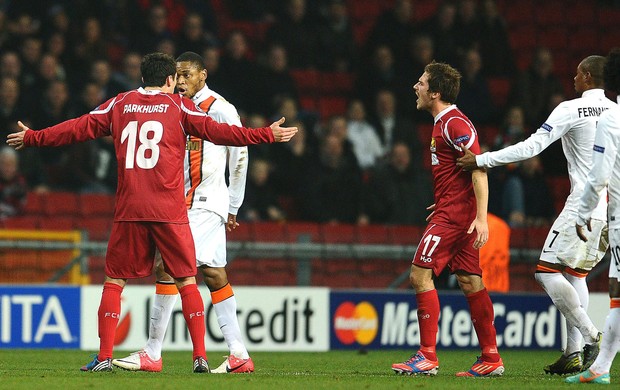 |
| USA International Michael Parkhurst confronts Luiz Adriano |
You can see the entire incident here:
Friday, November 9, 2012
Freshman Files: Kevis Pinto

Name: Kevis Georgakopoulos Pinto
Current Year: Junior
First Year Dorm: Caneris
Internships: Comcast SportsNet - Marketing
Area of interest: Sports Marketing, Sponsorship, and Coaching
What is your favorite memory from your first year at Drexel?
I didn't start off at Drexel as a freshman, I studies for a year and a half at a University in Rio de Janeiro. My first year here I really enjoyed being able to make new friends while playing intramural and club sports.
What is the most important thing that you learned about sport management and the sports industry?
That networking is key. The industry is smaller than it seems and all the people know each other. To get into sport business you need to be willing to sacrifice a lot of hours for not a very high pay.
What advice would you give to the freshman based on your experience?
Start networking now, and if possible start looking at some internships or volunteer experience to build up a strong resume.
If you could do it all over again, what would you do different?
I would've gotten involved earlier, volunteering and interning since freshman year. The more experience you can get, the better!
Previous: Kevin Rossi
Previous: Kevin Murray
Previous: Dan Mullin
Previous: Hayley Zedeck
Previous: Greg Monforte
Previous: Ryan Pratt
Previous: Kevin Giordano
Wednesday, October 24, 2012
Global Scope: World Soccer's Awards
We are getting closer to the end of the year and at the end of every year there are a few international awards for top players, coaches, and teams in the wide world of football. One of the most prestigious of these awards is given out by the British magazine World Soccer. Well regarded as the world's top magazine for international football fans, they give out an award every year for the best player, young player, manager, and team of the year. One of the main reason's as to why their awards are so special for players is because it is 100% decided by fans. Fans will vote on the magazine's website and the results are out on the magazine's January edition (released to the public in December).
The top player award was first handed out in 1982 for Juventus and Italy's Paolo Rossi who received 23% of the votes. In 1982 Rossi won the Italian first division (Serie A) with Juventus FC and the FIFA World Cup with the Italian national team where he was the competition's top goal scorer (6 goals), and scored one of the three goals in the final versus West Germany. After Rossi the award moved forward, passing through players such as Zico, Maradona, Maldini, and many other legends until it was last handed out to Lionel Messi. In 2011 Messi was awarded top player for the second time, first being in 2009, and with a record breaking percentage of 60.2%. The awards for coach of the year, young player of the year, and world team of the year were last awarded to Josep Guardiola (Barcelona), Neymar (Santos), and FC Barcelona respectively.
This year's list of finalists for the awards really do represent what fans have been watching in international football and is filled with interesting stories. The finalists for top player are Drogba (Chelsea/Shanghai Shenhua), Radamel Falcao (Atletico Madrid), Eden Hazard (Lille/Chelsea), Andres Iniesta (Barcelona), Lionel Messi (Barcelona), Neymar Junior (Santos), Andrea Pirlo (Juventus), Cristiano Ronaldo (Real Madrid), Yaya Toure (Manchester City), and Xavi Hernandez (Barcelona). There really is a case to be made for every one of those players to win the top player award, but it is likely that it will end with Messi, Ronaldo, or Iniesta. Messi had a fantastic scoring record last season with 73 goals in 60 appearances with Barcelona, while Ronaldo and Iniesta led their teams to success in the Spanish First Division and the Eurocup 2012.
The finalists for the award of best coach of the year travels the globe from South America, to Europe, and to Africa. The ten coaches in the mix are Marcelo Bielsa (Athletic Bilbao), Vicente del Bosque (Spain), Roberto Di Matteo (Chelsea), Rene Girard (Montpellier), Jurgen Klopp (Borussia Dortmund), Jose Mourinho (Real Madrid), Diego Simeone (Atletico Madrid), Luis Tena (Mexico Olympic Team), Tite (Corinthians), Herve Renard (Zambia). There are so many interesting and successful story lines in this mix that it is tough to only pick one, so I'll pick three. The Italian Roberto Di Matteo, who is a Chelsea former player, was brought in to fill the gap left by Andre Villas-Boas he led his squad to win the UEFA Champions League for the first time. Jose Mourinho was able to finally stay ahead of FC Barcelona and win the Spanish First Division with Real Madrid after four years, where Barcelona won for three years in a row. There is also Tite, the coach of Brazilian side Corinthians FC, who last season won the Brazilian league and this year the Copa Libertadores da America (equivalent to the UEFA Champions League in South America) for the first time. There is also a very special mention to be left for French head coach of the Zambian national team Herve Renard. He was able to take a fragile Zambian squad to their first ever African Cup of Nations title win in 2012. Zambia beat favorites Senegal in the group stages and then defeated Ghana in the semi finals and the Ivory Coast in the final. The win was made even more special when the team dedicated this historic accomplishment to the 18 players who died in a plane crash in April of 1993.
 Finally, up for the award for best world team of the year are Atletico Madrid (Spain), Borussia Dortmund (Germany), Chelsea (England), Corinthians (Brazil), Juventus (Italy), Mexico, Montpellier (France), Spain, Universidad de Chile (Chile), and Zambia. In this list again they are all well deserving of this award. Chelsea winning their first ever Champions League, Dortmund with back to back league titles, and even Universidad de Chile with an impressive Copa Sul Americana win. However I am going to pick three teams to keep the same pattern. The favorite for this award is Spain, winning their third major title consecutively and consolidating their place in history. Following not too far behind is Juventus FC who bounced back after a few tough years and won the Italian first division (Serie A) in undefeated fashion. Finally, the third candidate would be the incredible Zambian national team. Beating African powerhouses on their way to Nations Cup success for the first time ever.
The top player award was first handed out in 1982 for Juventus and Italy's Paolo Rossi who received 23% of the votes. In 1982 Rossi won the Italian first division (Serie A) with Juventus FC and the FIFA World Cup with the Italian national team where he was the competition's top goal scorer (6 goals), and scored one of the three goals in the final versus West Germany. After Rossi the award moved forward, passing through players such as Zico, Maradona, Maldini, and many other legends until it was last handed out to Lionel Messi. In 2011 Messi was awarded top player for the second time, first being in 2009, and with a record breaking percentage of 60.2%. The awards for coach of the year, young player of the year, and world team of the year were last awarded to Josep Guardiola (Barcelona), Neymar (Santos), and FC Barcelona respectively.
This year's list of finalists for the awards really do represent what fans have been watching in international football and is filled with interesting stories. The finalists for top player are Drogba (Chelsea/Shanghai Shenhua), Radamel Falcao (Atletico Madrid), Eden Hazard (Lille/Chelsea), Andres Iniesta (Barcelona), Lionel Messi (Barcelona), Neymar Junior (Santos), Andrea Pirlo (Juventus), Cristiano Ronaldo (Real Madrid), Yaya Toure (Manchester City), and Xavi Hernandez (Barcelona). There really is a case to be made for every one of those players to win the top player award, but it is likely that it will end with Messi, Ronaldo, or Iniesta. Messi had a fantastic scoring record last season with 73 goals in 60 appearances with Barcelona, while Ronaldo and Iniesta led their teams to success in the Spanish First Division and the Eurocup 2012.
The finalists for the award of best coach of the year travels the globe from South America, to Europe, and to Africa. The ten coaches in the mix are Marcelo Bielsa (Athletic Bilbao), Vicente del Bosque (Spain), Roberto Di Matteo (Chelsea), Rene Girard (Montpellier), Jurgen Klopp (Borussia Dortmund), Jose Mourinho (Real Madrid), Diego Simeone (Atletico Madrid), Luis Tena (Mexico Olympic Team), Tite (Corinthians), Herve Renard (Zambia). There are so many interesting and successful story lines in this mix that it is tough to only pick one, so I'll pick three. The Italian Roberto Di Matteo, who is a Chelsea former player, was brought in to fill the gap left by Andre Villas-Boas he led his squad to win the UEFA Champions League for the first time. Jose Mourinho was able to finally stay ahead of FC Barcelona and win the Spanish First Division with Real Madrid after four years, where Barcelona won for three years in a row. There is also Tite, the coach of Brazilian side Corinthians FC, who last season won the Brazilian league and this year the Copa Libertadores da America (equivalent to the UEFA Champions League in South America) for the first time. There is also a very special mention to be left for French head coach of the Zambian national team Herve Renard. He was able to take a fragile Zambian squad to their first ever African Cup of Nations title win in 2012. Zambia beat favorites Senegal in the group stages and then defeated Ghana in the semi finals and the Ivory Coast in the final. The win was made even more special when the team dedicated this historic accomplishment to the 18 players who died in a plane crash in April of 1993.
 Finally, up for the award for best world team of the year are Atletico Madrid (Spain), Borussia Dortmund (Germany), Chelsea (England), Corinthians (Brazil), Juventus (Italy), Mexico, Montpellier (France), Spain, Universidad de Chile (Chile), and Zambia. In this list again they are all well deserving of this award. Chelsea winning their first ever Champions League, Dortmund with back to back league titles, and even Universidad de Chile with an impressive Copa Sul Americana win. However I am going to pick three teams to keep the same pattern. The favorite for this award is Spain, winning their third major title consecutively and consolidating their place in history. Following not too far behind is Juventus FC who bounced back after a few tough years and won the Italian first division (Serie A) in undefeated fashion. Finally, the third candidate would be the incredible Zambian national team. Beating African powerhouses on their way to Nations Cup success for the first time ever.
Wednesday, October 10, 2012
Global Scope: European Soccer Market
The United States of America is very unique in terms of their sports market. There are four, potentially five (if include the MLS) different sports that are generating money every year, with an already established and clear market. The four major sports/leagues in the USA are the National Football League, Major League Baseball, National Basketball Association, and the National Hockey League. However, in Europe (similar to many parts of the world) there isn't really an already established and clear market for multiple sports. Depending on which part of Europe you are looking at there might be only football, while others may have a strong market for rugby, basketball, and other popular sports. Given the fact that most of Europe concentrates mainly in football, the biggest sponsorship deals are going to be found within the football teams.
A partnership between two consulting agencies, Sport Intelligence and PR Marketing, released information about the sponsorship deals that are made between European football clubs and major multinational brands. It is interesting to see the partnerships that have been maintained for very long periods of time, highlighting the one between Bayern Munich and Adidas, that has been going strong for over 40 years. This year both sides also agreed to extend their partnership at least until 2020. Another interesting observation is that from the ten clubs listed below, all have deals with either Adidas or Nike except for Liverpool FC. This is the first year that Liverpool's kit is supplied by Warrior, an American company that is trying to get into the football market. Liverpool FC is owned by an American company called Fenway Sports Group (also the owners of the Boston Red Sox) since October of 2010 when they also bought Liverpool's home ground, Anfield.

A succesful partnership must be beneficial for both sides, and its not different when dealing with European football. These major brands such as nike and adidas are also making a lot of money with the partnerships with European clubs. As you can see below it seems that Adidas is leading in this category, but taking into consideration that Umbro is now a part of Nike, they end up with the top spot with 40% of the market share.

A partnership between two consulting agencies, Sport Intelligence and PR Marketing, released information about the sponsorship deals that are made between European football clubs and major multinational brands. It is interesting to see the partnerships that have been maintained for very long periods of time, highlighting the one between Bayern Munich and Adidas, that has been going strong for over 40 years. This year both sides also agreed to extend their partnership at least until 2020. Another interesting observation is that from the ten clubs listed below, all have deals with either Adidas or Nike except for Liverpool FC. This is the first year that Liverpool's kit is supplied by Warrior, an American company that is trying to get into the football market. Liverpool FC is owned by an American company called Fenway Sports Group (also the owners of the Boston Red Sox) since October of 2010 when they also bought Liverpool's home ground, Anfield.

A succesful partnership must be beneficial for both sides, and its not different when dealing with European football. These major brands such as nike and adidas are also making a lot of money with the partnerships with European clubs. As you can see below it seems that Adidas is leading in this category, but taking into consideration that Umbro is now a part of Nike, they end up with the top spot with 40% of the market share.

Wednesday, September 26, 2012
Global Scope: Sports Marketing
Marketing campaigns are a great way to get fans connected to their favorite players, teams, leagues. Here in the United States it is very common to see teams, leagues and even players create marketing campaigns that serve the purpose of getting closer to the fans. This is nothing new for anyone who follows big time American sports, but for football (soccer) fans in other parts of the Americas it is a totally different reality. Professional sports teams and organizations in Brazil, for example, function in a very amateur form. Since there are very few sports professionals, most executive offices have former players or known figures making decisions that they are probably not prepared to make.
With Brazil winning the bid to host the 2014 FIFA World Cup/2013 Confederations Cup, and the 2016 Olympics there has been a start of a "catching up" phase. Most of the people with resources are looking into sports as possible new investments, and a lot of sport agencies are being created where a market for sports business was barely even existent. Higher education institutions are quickly preparing themselves to offer undergraduate programs in sport management, with professors specializing themselves overseas and then coming back to teach. It was only a matter of time until this "sports business epidemic" caught on over there.
There are two specific cases that were really interesting. One is with a first division club called Botafogo FR from Rio de Janeiro and the other was with EC Vitória, a second division team (on pace to make it back to the first division) from Salvador. The first campaign was a partnership between Botafogo and its athletic equipment sponsor, Puma. They decided to make the team's third option uniforms in gold, instead of the team's traditional colors of black and white. The reason behind it was that it was supposed to be in honor of Botafogo's fans. The team was going to wear it for the first time on September 23rd's match against reigning Brazilian champions Corinthians FC. Puma and Botafogo then decided to get 11 fans that had "season tickets" and give them the chance to watch the game from a special luxury box, with the presence of some former players. However, they also surprised the fans by having 11 flags in the stands with their names on them and the 11 starters for Botafogo that day would play the entire game with the fans' names on the back of their jerseys.
With Brazil winning the bid to host the 2014 FIFA World Cup/2013 Confederations Cup, and the 2016 Olympics there has been a start of a "catching up" phase. Most of the people with resources are looking into sports as possible new investments, and a lot of sport agencies are being created where a market for sports business was barely even existent. Higher education institutions are quickly preparing themselves to offer undergraduate programs in sport management, with professors specializing themselves overseas and then coming back to teach. It was only a matter of time until this "sports business epidemic" caught on over there.
There are two specific cases that were really interesting. One is with a first division club called Botafogo FR from Rio de Janeiro and the other was with EC Vitória, a second division team (on pace to make it back to the first division) from Salvador. The first campaign was a partnership between Botafogo and its athletic equipment sponsor, Puma. They decided to make the team's third option uniforms in gold, instead of the team's traditional colors of black and white. The reason behind it was that it was supposed to be in honor of Botafogo's fans. The team was going to wear it for the first time on September 23rd's match against reigning Brazilian champions Corinthians FC. Puma and Botafogo then decided to get 11 fans that had "season tickets" and give them the chance to watch the game from a special luxury box, with the presence of some former players. However, they also surprised the fans by having 11 flags in the stands with their names on them and the 11 starters for Botafogo that day would play the entire game with the fans' names on the back of their jerseys.
This is the campaign video
The second campaign, and in my opinion one of the best marketing campaigns I've ever heard of, was by EC Vitória, a very prestigious club in the city of Salvador. The team's official colors are red and black, but for this specific campaign they tweaked that a little and became a black and white team. The team's number 1 kit is composed of horizontal thick red and black stripes. For this campaign, the team started out with its four red stripes becoming white, turning the uniform into black and white horizontal stripes. The team partnered with a local blood bank in Salvador and every time the number of blood donors increased a certain amount, one of the stripes would become red again. The results were so impressive that it made the team's biggest rival, EC Bahia also from Salvador, want to do something similar. The local blood bank was receiving thousands of fans coming in with one of the two team's jerseys, and the rival fans admitted to going because of the campaign. Now, EC Bahia's marketing department is working on a new marketing venture to dive into and make their fans proud as well.
This is the campaign video (unfortunately only in portuguese, but still interesting just to have a feel from it)
Wednesday, September 12, 2012
Global Scope: European Success
The UEFA European Football Championship is the most prestigious competition in all of Europe. Since 1960 where the tournament was first held in France, there have been 14 European Football Championships culminating with EURO 2012 hosted by Poland and Ukraine. This was the third time the European championship was co-hosted by two different nations (2000 - Belgium/Netherlands and 2008 - Austria/Switzerland), but only the first time it was hosted by two "struggling nations." This was, however, a part of UEFA president Michel Platini's plan to get European countries with lower international prestige a chance to succeed. Leading into the EURO 2012 competition, the people and media throughout the world were still skeptical as to how this joint hosting venture would pan out. As far as UEFA is concerned, financially, it was a success!
There is a total of 575 clubs that are going to share the benefits of UEFA EURO 2012, according to the new memorandum of understanding which was signed between UEFA and the European Club Association (ECA) in March of this year. Yesterday was when UEFA finalized the calculation of the amounts to be paid to UEFA member associations for them to pass on to those of their clubs which contributed to the success of UEFA EURO 2012 and national team football in Europe. This year there are 575 clubs that will benefit, which is a huge increase when compared to the distribution after the UEFA EURO 2008, when 180 clubs only received payments.
After analyzing this year`s financials UEFA made 100 million euros available for distribution, with 40 million reserved for clubs that released players during qualifying matches. The other 60 million euros will go to the clubs that released players for the final tournament in Poland and Ukraine. Clubs receive an equal share per player released for each qualifying match, and a fixed amount per player per day for the final tournament, weighted with the FIFA categorization of clubs for training compensation.
In order to be eligible for a share of the benefits from UEFA EURO 2012 clubs were asked to fill in, sign and return a club application form to UEFA, in which they agreed in particular to support national team competitions and to comply with the FIFA regulations on the release of players. This succesful partnership between the ECA and UEFA was evident during the UEFA EURO 2012 competition, and culminated with the financial success that UEFA and the ECA are experiencing now. UEFA President Michel Platini has stated that this system is proving to be ideal, with clubs peacefully releasing players to play in international play, knowing that they will later be financially compensated.
The top six clubs participating in the benefits of UEFA EURO 2012 are:
1) FC Bayern München €3,095,393 2) Real Madrid CF €2,996,585 3) FC Barcelona €2,210,202 4) Manchester City FC €2,069,465 5) Juventus €2,023,012 6) Liverpool FC €1,972,376
The plan for UEFA EURO 2016 in France is to target a total amount of 150 million euros available for distribution.
There is a total of 575 clubs that are going to share the benefits of UEFA EURO 2012, according to the new memorandum of understanding which was signed between UEFA and the European Club Association (ECA) in March of this year. Yesterday was when UEFA finalized the calculation of the amounts to be paid to UEFA member associations for them to pass on to those of their clubs which contributed to the success of UEFA EURO 2012 and national team football in Europe. This year there are 575 clubs that will benefit, which is a huge increase when compared to the distribution after the UEFA EURO 2008, when 180 clubs only received payments.
After analyzing this year`s financials UEFA made 100 million euros available for distribution, with 40 million reserved for clubs that released players during qualifying matches. The other 60 million euros will go to the clubs that released players for the final tournament in Poland and Ukraine. Clubs receive an equal share per player released for each qualifying match, and a fixed amount per player per day for the final tournament, weighted with the FIFA categorization of clubs for training compensation.
In order to be eligible for a share of the benefits from UEFA EURO 2012 clubs were asked to fill in, sign and return a club application form to UEFA, in which they agreed in particular to support national team competitions and to comply with the FIFA regulations on the release of players. This succesful partnership between the ECA and UEFA was evident during the UEFA EURO 2012 competition, and culminated with the financial success that UEFA and the ECA are experiencing now. UEFA President Michel Platini has stated that this system is proving to be ideal, with clubs peacefully releasing players to play in international play, knowing that they will later be financially compensated.
The top six clubs participating in the benefits of UEFA EURO 2012 are:
1) FC Bayern München €3,095,393 2) Real Madrid CF €2,996,585 3) FC Barcelona €2,210,202 4) Manchester City FC €2,069,465 5) Juventus €2,023,012 6) Liverpool FC €1,972,376
The plan for UEFA EURO 2016 in France is to target a total amount of 150 million euros available for distribution.
Thursday, August 30, 2012
Young Man Game
Neymar da Silva Santos Junior is a 20 year old kid from Mogi das Cruzes, Brazil and is his country's number one hope to win the next FIFA World Cup at home. This young boy carries the weight of over 190 million people on his shoulder but does not seem to mind it. The young super star was described by Pelé (the greatest football player of all time) as a "technical marvel, a wizard with magical feet." The talent is definitely there no doubt about that, but is he headed in the right direction off the field, financially?
 Neymar is reportedly making $18 million per year, and is by far the most well paid athlete in all of Brazil. He has already closed endorsement deals with 10 companies that are local and international (Red Bull, Panasonic, Lupo, Claro, Heliar, Tennys Pé, Guaraná Antartica, Santander Bank, Unilever, Volkswagen) and has a private deal signed with Nike until 2022. Neymar's earnings off the field are estimated at around $12 million. Neymar Jr's dad, Neymar Senior is the main person in charge of his son's career and earnings, and has recently acquired help from Santos FC, which is the team that the young Neymar plays for. Santos had to create a separate department that only takes care of Neymar's image, and they appointed a marketing specialist as the head of the newly created department. Also, former world football star Ronaldo's sports marketing firm 9ine is helping out with managing the young Neymar's career and image.
However in two years approximately, Neymar reportedly bought a $750,000 triplex and a $2 million mansion in a gated condominium, both located in the city of Santos; a $150,000 flat in the city of São Paulo, and a Porsche Panamera Turbo which costed around $550,000. Also, Neymar is the father of young Davi Lucca and he gave the 18-year-old mother of his son a penthouse that is worth $1 million in the city of Santos plus $15,000 per month in child support. The icing on the cake of the young star's spending frenzy was his purchase of an Italian yacht, for which he paid $8 million without the roughly estimated $120,000 he will have to pay for maintenance per year.
Neymar has reportedly stated that his dad is in charge of his expenses and that he is only allowed to buy something after his dad has approved it. An interesting story, that can be used as evidence for Neymar's claim, was when in the final match of the "Junior World Cup 2011" Neymar scored two goals in his team's win against Uruguay 6-0. After scoring the fifth goal of the match and his second, he celebrated by running around the field making the motion of steering a car's wheel with his hands. At the time television analysts and sports commentators thought it was because the tournament's top goal scorer (Neymar with 9) was awarded a car from the tournament's main sponsor. However, he later revealed it was because his dad made a list of achievements for him and the final one was to score two goals in the world cup final, so he could get a new car (a Porsche Panamera Turbo).
To the greatest football nation in the world Neymar is standing as their number one hope for glory at home in 2014. Brazil is going through a renovation with their national football team, and Neymar is the face of this transition. Fans are seeing a lot less of Ronaldinho and Kaka wearing the mystical canary kit, and a lot more of Neymar and Thiago Silva. Some people are angry at Neymar, arguing that such a young kid with such huge responsibilities should be more focused on football and less focused on off field luxuries, and that might be true, but he has never stopped producing and has won many titles with his team Santos. Recently Neymar was a part of the silver medal winning squad in London, which was a failure in the eyes of most Brazilians who were set on winning gold.
Neymar is reportedly making $18 million per year, and is by far the most well paid athlete in all of Brazil. He has already closed endorsement deals with 10 companies that are local and international (Red Bull, Panasonic, Lupo, Claro, Heliar, Tennys Pé, Guaraná Antartica, Santander Bank, Unilever, Volkswagen) and has a private deal signed with Nike until 2022. Neymar's earnings off the field are estimated at around $12 million. Neymar Jr's dad, Neymar Senior is the main person in charge of his son's career and earnings, and has recently acquired help from Santos FC, which is the team that the young Neymar plays for. Santos had to create a separate department that only takes care of Neymar's image, and they appointed a marketing specialist as the head of the newly created department. Also, former world football star Ronaldo's sports marketing firm 9ine is helping out with managing the young Neymar's career and image.However in two years approximately, Neymar reportedly bought a $750,000 triplex and a $2 million mansion in a gated condominium, both located in the city of Santos; a $150,000 flat in the city of São Paulo, and a Porsche Panamera Turbo which costed around $550,000. Also, Neymar is the father of young Davi Lucca and he gave the 18-year-old mother of his son a penthouse that is worth $1 million in the city of Santos plus $15,000 per month in child support. The icing on the cake of the young star's spending frenzy was his purchase of an Italian yacht, for which he paid $8 million without the roughly estimated $120,000 he will have to pay for maintenance per year.
Neymar has reportedly stated that his dad is in charge of his expenses and that he is only allowed to buy something after his dad has approved it. An interesting story, that can be used as evidence for Neymar's claim, was when in the final match of the "Junior World Cup 2011" Neymar scored two goals in his team's win against Uruguay 6-0. After scoring the fifth goal of the match and his second, he celebrated by running around the field making the motion of steering a car's wheel with his hands. At the time television analysts and sports commentators thought it was because the tournament's top goal scorer (Neymar with 9) was awarded a car from the tournament's main sponsor. However, he later revealed it was because his dad made a list of achievements for him and the final one was to score two goals in the world cup final, so he could get a new car (a Porsche Panamera Turbo).
To the greatest football nation in the world Neymar is standing as their number one hope for glory at home in 2014. Brazil is going through a renovation with their national football team, and Neymar is the face of this transition. Fans are seeing a lot less of Ronaldinho and Kaka wearing the mystical canary kit, and a lot more of Neymar and Thiago Silva. Some people are angry at Neymar, arguing that such a young kid with such huge responsibilities should be more focused on football and less focused on off field luxuries, and that might be true, but he has never stopped producing and has won many titles with his team Santos. Recently Neymar was a part of the silver medal winning squad in London, which was a failure in the eyes of most Brazilians who were set on winning gold.
Wednesday, August 22, 2012
Billion Dollar Giant
The Australian Rugby League Commission (ARLC) has agreed to a five year broadcasting agreement with Nine and Fox Sports in a deal worth more than $1 billion, which makes it the largest agreement in Rugby League history. It might not even end there, since the agreement allows Nine and Fox to show all the games in Australia, leaving the ARLC open to pursuing further broadcasting revenues in New Zealand. The agreement with Nine and Fox also includes a cash component of $925 million, $90 million of which will have to be paid before the start of the first season. Advertising packages of up to $100 million are also included in the same agreement. The Australian Rugby League Commission chair, John Grant said "This whole package is simply a fantastic result for Rugby League. The cash that comes from the agreement, used wisely, will provide the funding base for sustainably growing our game from the grassroots to the elite levels."
The Nine Network will broadcast three weekly matches, three Thursday evening matches during the year, 4 special events throughout the season, and 2 hours of Rugby League content every evening. Meanwhile, Fox will be showing five matches a week, starting on Saturday and ending on Mondays. Also, both channels will be providing coverage of The Four Nations tournament, one of the most prestigious international rugby competition in the world.
 National Rugby League (NRL) clubs are expected to receive an immediate $500,000 payment, and a salary cap of up to $6 million will be talked about next Monday at the inaugural meeting of the ARLC Council. This deal is a huge win for players, clubs and hopefully the development of the sport. The deal is showing a significant increase from the current deal that expires at the end of this season, of $500 million over a span of six years.
The NRL is well regarded as the top league of professional rugby league football clubs in Oceania. The current version of the league had its first season in 1998, and it is comprisef of 16 teams total, 15 in Australia and 1 in New Zealand. The most succesful team in the NRL is the South Sydney Rabbitohs with 20 titles in total (the last championship came in 1971). The NRL is also regarded as the top Rugby League championship in the world and is the single most viewed and attended rugby competition in the world per season. The season always culminates in the NRL Grand Final, one of Australia's most popular sporting events and also one of the world's largest attender club championship events.
The Nine Network will broadcast three weekly matches, three Thursday evening matches during the year, 4 special events throughout the season, and 2 hours of Rugby League content every evening. Meanwhile, Fox will be showing five matches a week, starting on Saturday and ending on Mondays. Also, both channels will be providing coverage of The Four Nations tournament, one of the most prestigious international rugby competition in the world.
National Rugby League (NRL) clubs are expected to receive an immediate $500,000 payment, and a salary cap of up to $6 million will be talked about next Monday at the inaugural meeting of the ARLC Council. This deal is a huge win for players, clubs and hopefully the development of the sport. The deal is showing a significant increase from the current deal that expires at the end of this season, of $500 million over a span of six years.The NRL is well regarded as the top league of professional rugby league football clubs in Oceania. The current version of the league had its first season in 1998, and it is comprisef of 16 teams total, 15 in Australia and 1 in New Zealand. The most succesful team in the NRL is the South Sydney Rabbitohs with 20 titles in total (the last championship came in 1971). The NRL is also regarded as the top Rugby League championship in the world and is the single most viewed and attended rugby competition in the world per season. The season always culminates in the NRL Grand Final, one of Australia's most popular sporting events and also one of the world's largest attender club championship events.
Subscribe to:
Posts (Atom)